
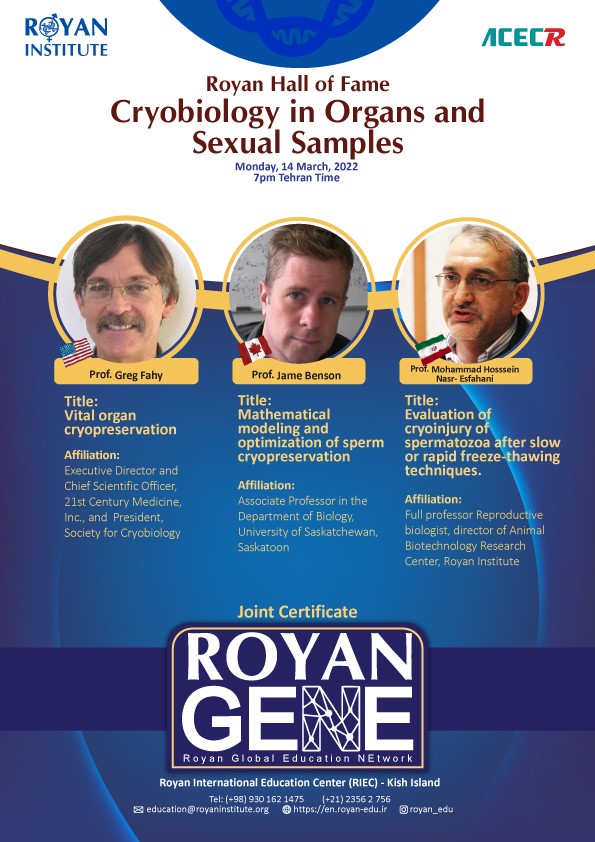
 The core essence and beliefs of creating Royan Global Education Network focus on bringing all scientific activities and research of multilateral interests under one umbrella so that all those interested in various fields of activities can enjoy the benefits and seize the opportunities coming along with its activities and programs which appear as two phenomena called “Hall of Fame” and “Dialogue with Fame”. As per this spirit of unity, the 7th round Royan GENE program was held on 14 March 2022 as a Hall of Fame in the realm of Cryobiology in Organs and Sexual Samples. This Hall of Fame webinar featured highly notable lecturers from all around the world whose topics and speeches led to a fruitful webinar and discussion sessions, starting with the lectures of Prof. Gregory M.Fahy, president of Society for Cryobiology; Prof. James Benson, University of Saskatchewan; and Prof. M.H Nasr-Esfahani, director of animal biotechnology from Royan Institute. The topics and lectures represented through this program were mainly concerned with:
Vital Organ Cryopreservation
Mathematical modeling and optimization of sperm cryopreservation
Evaluation of cryoinjury of spermatozoa after slow or rapid freeze-thawing techniques
- About
- Membership
- Publications
- Events
- Awards
- Jobs
- Partners
- Resources
- Donate

 Dr. Dan Distel and his team have launched a non-profit marine genome bank at the Northeastern University Marine Science Center called the
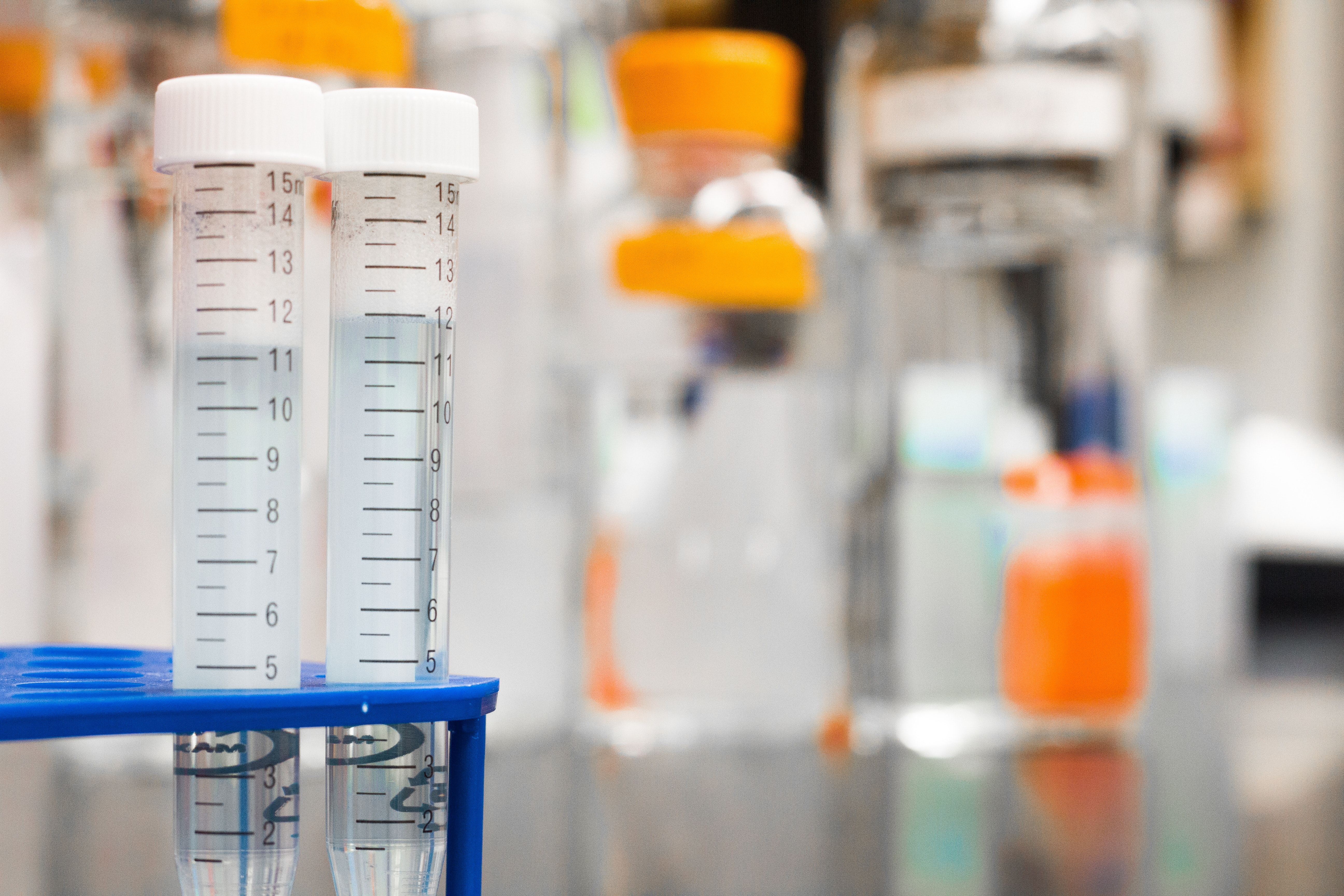 Advancing beyond growing and testing individual cell lines in the lab, UF Health scientists have discovered a novel method of cryopreserving lung tissue at -184°F with the intention of studying the impact of the coronavirus and COVID-19 on the tissue. A key ingredient in this new cryopreserving method is a protein found in Antarctic fish which inhibits the formation of ice crystals.
  A world without your favorite wine? At best you'll pay more; at worst you won't get it at all. Climate change and a lack of biodiversity are making some grape and wine varieties obsolete. The French National Institute for Research into Agriculture, Food, and the Environment (INRAE) has launched the cryopreservation of the world's largest collection of historical grapevines. This $12.1 million (€ 10.4 million) conservation center was built to protect and support plant tissue supplied by Domaine de Vassal, a 27-hectare vineyard, with grapevines collected from the 1870s and will be stored in cryobanks of liquid nitrogen at -196°C. INRAE researcher, Phillippe Chatelet says the primary challenge will be the safe regeneration of these vine tissues.

 Patients in the UK will now have more time to decide their family planning after government changes the egg, sperm, and embryo storage regulations. Presently fertility storage is limited based on medical needs and limited to a 10 year period. After the successful campaign by the Progress Educational Trust, the new regulations will open fertility storage to more people who choose fertility storage for medical or social reasons and provide a 10-year renewable storage cycle for a maximum of 55 years. Fertility advances mean human eggs can be stored indefinitely without deterioration using vitrification, making the current 10-year limit obsolete. Additional conditions surrounding third-party donors and posthumous use will be investigated and regulated separately.

 In a recent interview with the Hawaiian Public Radio, Mary Hagedorn, a
 Back from the dead... Bdelloid Rotifers are multicellular microscopic animals with a wheel-like ring of tiny hairs that circle their mouths and that live in freshwater environments. They've been around for about 50 million years. Now, scientists from the Institute of Physicochemical and Biological Problems in Soil Science in Pushchino, Russia have resuscitated rotifers that froze in ancient Siberian permafrost during the latter part of the Pleistocene epoch (2.6 million to about 11,700 years ago). These researchers drilled to 11.5 feet (3.5 meters) below the Siberia Alazeya River surface to collect their samples. The soil was radiocarbon dated at ~24,000 years old. Once thawed in the lab, these "zombie" rotifers reanimated and began reproducing asexually through parthenogenesis and created clones that were their genetic duplicates.
  Scientists at UC Santa Barbara, University of Southern California (USC), and the biotechnology company Regenerative Patch Technologies LLC (RPT) have discovered a new method for preserving RPT's stem cell-based therapy for age-related macular degeneration (AMD), the leading cause of blindness in aging populations. This new research uses a flexible scaffold, about 18 mm2, to optimize the cryopreservation of a single layer of ocular cells generated from human embryonic stem cells. Currently in clinical trials, this implant can be frozen, stored for long periods, distributed to clinical sites, then thawed and immediately implanted into the patient's eyes. The extended shelf-life and on-demand distribution will increase the number of patients who can benefit from this treatment.
 The Drosophila melanogaster fruit fly, a critical genetic research model, has eluded scientist's attempt to cryopreserve the embryos until now. A research team from the University of Minnesota and